Your professional supplier of electronic switches, sockets, and connectors!


Introduction to the function and installation precautions of push-button switches
Oct 10,2022
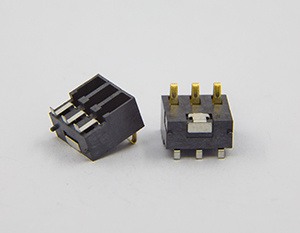
Push-button switches primarily refer to tactile push-button switches, also known as touch switches. Push-button switches are electronic switches and belong to electronic components. They first appeared in Japan. When using them, press the switch in the operating direction to meet the operating force. When the pressure is released, the switch closes, and its internal structure switches on and off through the stress change of the metal leaf. Push-button switches consist of an insert, base, elastic sheet, button, and cover plate. The waterproof push-button switch has a polyimide film added to the elastic sheet.
The function of a push-button switch: Generally, a push-button switch does not directly control the on/off of the main circuit (high-current circuit), but only sends command signals in the control circuit (low-current circuit) to control electrical appliances such as contactors and relays, thereby controlling the on/off, function switching, or electrical interlocking of the main circuit. Typically, a button consists of a button cap, reset spring, bridge-type moving contact, static contact, pillar connecting rod, and housing. When the button is not subjected to external force (i.e., static), the on/off state of the contacts can be divided into stop buttons (i.e., normally open buttons), start buttons (i.e., normally closed buttons), and composite buttons (i.e., buttons that combine normally closed and normally open contacts).
Installation precautions for push-button switches: 1. When installing push-button switches on the panel, they should be arranged reasonably and neatly. According to the starting order of the motor, they can be arranged from top to bottom or from left to right. 2. The push-button switches should be firmly installed and wired reliably. Usually, the red button indicates stop, and the green or black button indicates start or power on. Do not make mistakes during installation. 3. Because the distance between the contacts of the push-button switch is small, once oil stains are attached, short-circuit faults are likely to occur, so the contacts must be kept clean. 4. The button plate and button box should be made of metal and connected to the main grounding busbar of the machine tool as much as possible. For hanging buttons, a dedicated grounding wire should be provided, and metal pipes should not be used as grounding wires. 5. When buttons are used in high-temperature environments, they are prone to deformation and plastic aging, leading to loosening and short circuits between connecting screws. An insulating plastic tube can be added to the connecting screw to prevent short circuits. 6. Push-button switches with indicator lights are prone to plastic lampshade deformation due to heat generated by the bulb. The bulb voltage should be reduced to extend the service life. 7. The "stop" button should be red, the "emergency stop" button should be a red mushroom head type, and the "start" button should be equipped with a protective ring. The protective ring should be higher than the button head to prevent accidental touch and misoperation of electrical equipment.
Push-button switches may be relatively simple components in electrical circuits, but they do control the lifeblood of the entire control circuit, so they are also called “master switch”. For beginners, understanding various push-button switches and using them skillfully and flexibly can achieve twice the result with half the effort.

Contact Us
Email:
sales02@jbl-hk.com
sales03@jbl-hk.com
Tel/WeChat:
86769-83339091 / 83339095
Address:No. 5, Xinhuan Road, Langbei Village, Changping Town, Dongguan City, Guangdong Province

Address: No. 5, Xinhuan Road, Langbei Village, Changping Town, Dongguan City, Guangdong Province
Tel: 86769-83339091 / 83339095
Tel: 86769-83984933 / 83984936
Fax: 86769-83984949
Email: sales02@jbl-hk.com / sales03@jbl-hk.com
Email: sales08@jbl-hk.com / sales9@jbl-hk.com
Contact Us

Miss Wang

Mr. Zeng


